
From Alphonse Mucha’s groundbreaking 19th-century poster to Tadashi Kawamata’s site-responsive installations, the world’s oldest champagne house Ruinart has made artistic freedom, environmental consciousness and cultural patronage defining elements of its identity
Free Spirit
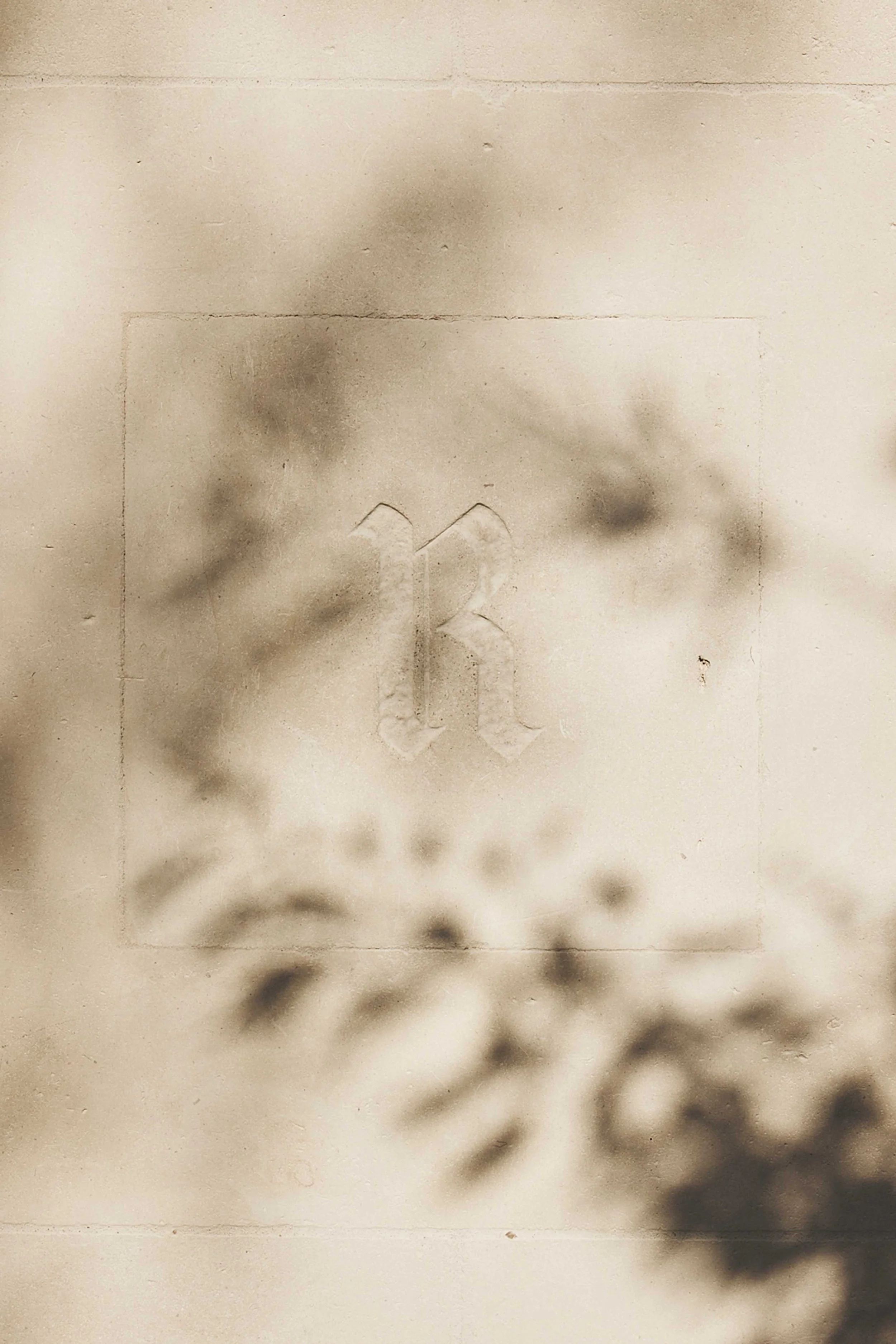
Number 4 rue des Crayères in Reims, north-eastern France, is synonymous with champagne. But the sparkling beverage is only part of the story: art spills from rooms in the historic estate into Sou Fujimoto’s luminous pavilion, punctuates the sculpture garden and descends through the chalk cellars. The latest intervention comes from Tadashi Kawamata, whose reused wood structures and lookout points tune visitors in to shifting light, wind and humidity.
The instinct runs deep. Since the 19th century, the Ruinart family has collected antiquities, Renaissance bronzes, coins and paintings, and has commissioned portraits and employed artists and musicians to educate their children. One descendant, André Ruinart, recognised the potential of Czech painter Alphonse Mucha after seeing his poster depicting French actress Sarah Bernhardt.
As Fabien Vallérian, Ruinart’s international director of arts and culture, recounts, ‘André Ruinart wanted something just as innovative and impactful for the maison, something very contemporary. Art Nouveau was totally new at the time. It was a bit shocking, not the academic style — like street art today.’ Mucha’s sinuous 1896 lithograph became the first known advertisement ever commissioned by a champagne house.
That meeting of art and craft evolved into a uniquely French art de vivre linking champagne with gastronomy, hospitality and culture. Ruinart formalised this relationship
in 2008 with Carte Blanche, inviting artists to respond to the maison through their own creative practice with a focus on craft, savoir- faire, history and Ruinart’s values. Erwin Olaf captured the human and geological traces inside the estate’s chalk cellars in 26 black and white photographs; Jaume Plensa used letters originating from eight alphabets in cut metal to create a sculptural homage to visionary monk Dom Thierry Ruinart, whose nephew drew on his work to found the maison.
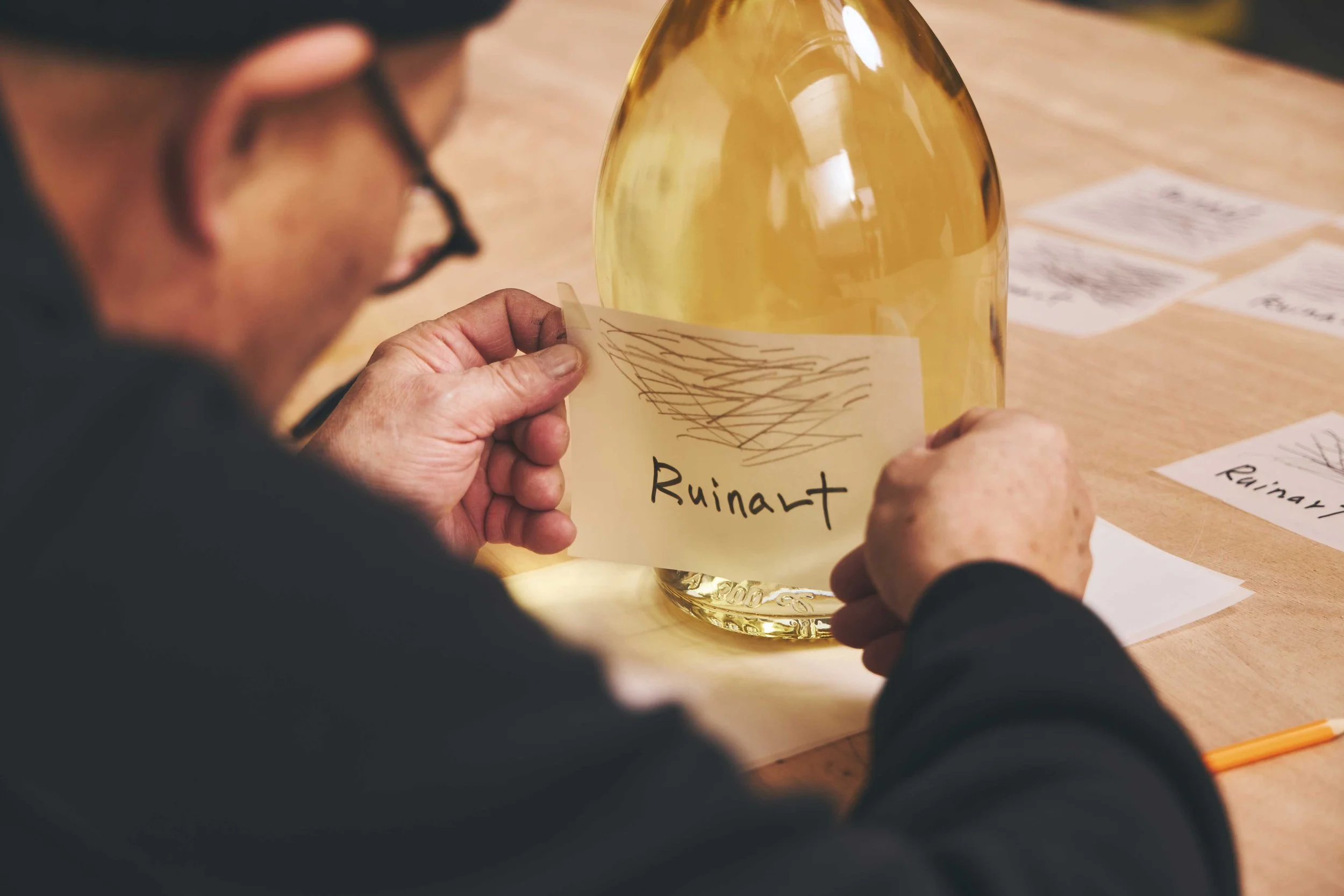
Since its founding, champagne house Ruinart has maintained a strong association with the arts. This continues in the Conversations with Nature series, in which the house draws attention to issues of climate and ecology. For 2026, Japanese artist Tadashi Kawamata has created a series of interactive installations across the house’s heritage estate in Reims, accompanied by bespoke labelling and packaging. Photography by Florie Berger
From 2018, nature moved further into the frame. Liu Bolin disappeared into the vineyards and production spaces, highlighting the people behind the wine. Vik Muniz fashioned images from blackened wood, charcoal and organic matter; David Shrigley responded with 42 witty illustrations; and Tomás Saraceno’s fossil fuel-free Aerocene sculpture floated above the vineyard, fully embracing the surrounding landscape while making a trenchant point about climate change. ‘If we invite artists that have a strong social and ecological commitment, they’ll bring something that’s very dear to us and that we want to tell the public,’ Vallérian explains.
Now titled Conversations with Nature, the art series tackles biodiversity and climate change through varied artistic practices. ‘Art is in our DNA and rooted in our heritage,’ says Vallérian. Artists undertake residencies in Champagne, meeting Ruinart’s winemakers and wine growers before exploring the vineyards and cellars. ‘We give them a lot of freedom,’ Vallérian adds. ‘It’s really the core of our method: to give the artist a very open invitation and no brief.’
Selection favours artistic rigour, environmental engagement and an ability to connect with a broad audience. ‘We look for handmade art that brings emotions to the viewer,’ Vallérian explains. ‘We want the art to be accessible to large audiences, even if they don’t know the artist or don’t care about contemporary art. It must create a dialogue with the viewer.’
Well beyond Reims, Ruinart also participates in approximately 35 art fairs and events annually, including Art Basel, Frieze, Paris Photo, Kyotographie, Art SG and TEFAF. ‘The idea is to showcase the artist and the work they create for Ruinart in the best possible way, and art fairs are interesting because you can touch a large number of people in a very limited time,’ says Vallérian.
The maison is counting down to its 300th anniversary in 2029 with a series of ten artworks being installed on the grounds. But beyond the milestone, Vallérian wants to build ‘an art programme that stands the test of time, that will still be enjoyable decades from now, choosing artists who we believe have a future. It’s also about creating attraction for the terroir, so it doesn’t benefit just us, but the other cultural actors too, which will attract visitors to the Champagne region for a long time.’
Nature’s Touch
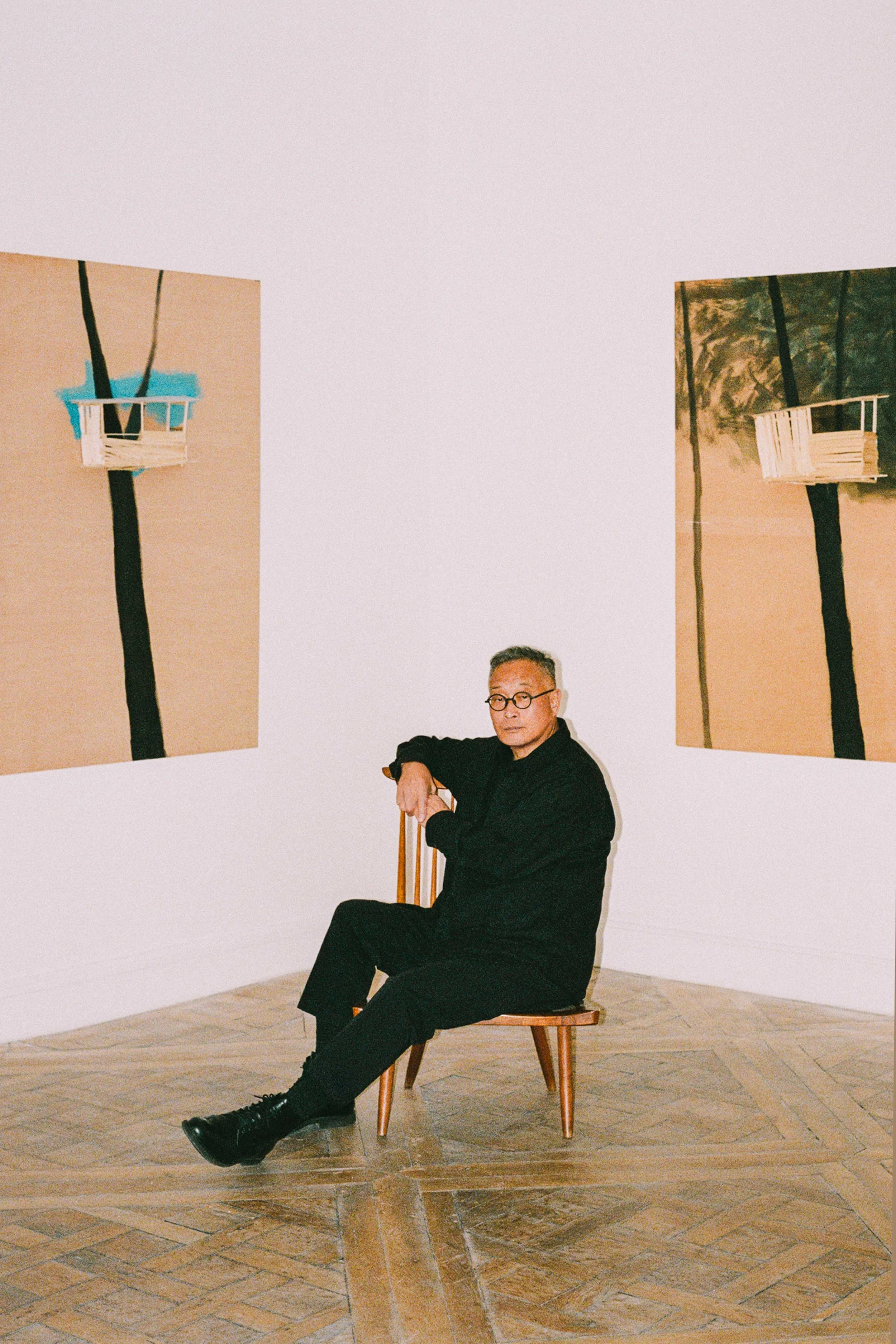
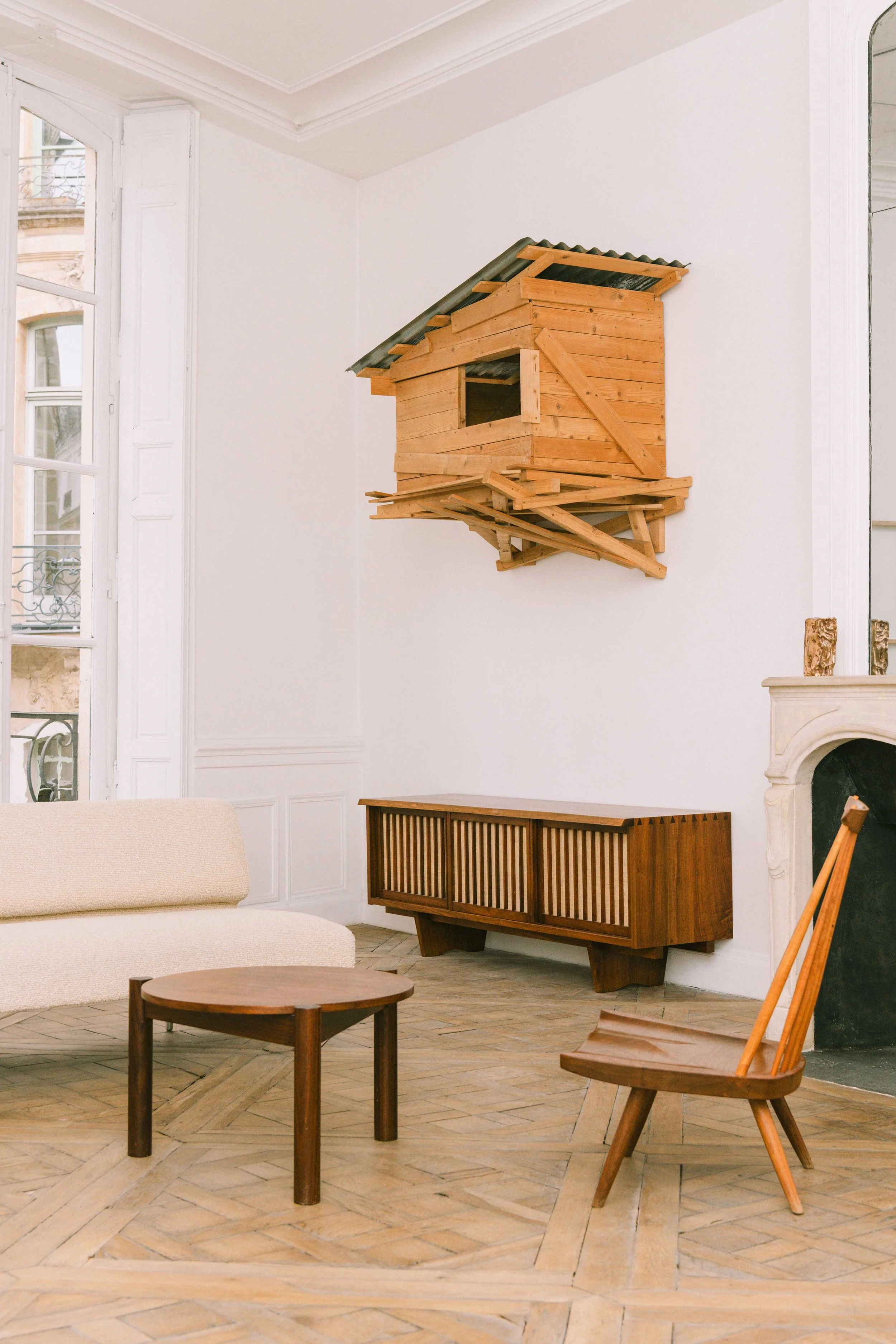
Tadashi Kawamata builds structures designed to disappear. In a year-long collaboration with Maison Ruinart, the Japanese artist brings his philosophy of impermanence to the maison’s historic estate in Reims, and most recently Art Week Tokyo — a reminder that the most enduring things are often those built to be let go
Tadashi Kawamata has spent five decades proving that the most powerful works of art are not always the ones that endure. His sprawling structures of reclaimed timber, perched precariously on buildings, wrapped around trees or spilling across urban landscapes, are designed to disappear. For the Japanese artist, physical permanence has never been the point.
That philosophy finds perhaps its most poetic expression in his collaboration with Maison Ruinart for its Conversations with Nature programme. Beginning with the temporary Tornado and Nest installations unveiled at Palais de Tokyo in Paris last February, progressing to three permanent site-specific works at the champagne house’s historic estate at 4 Rue des Crayères in Reims, and culminating in exhibitions at art fairs across the globe, the project is an ongoing exchange between landscape, craft and time.
The partnership feels remarkably natural. Ruinart champagne is shaped by seasons, chalk, vines and patience; Kawamata’s practice is built on recycled materials and transformation. Both embrace processes measured not in fleeting moments but in years. That sensitivity to nature can be traced back to Kawamata’s childhood in Hokkaido. Born in a village where his father worked as a coal miner, he was ‘surrounded by nature, walking in the mountains and swimming in the river,’ he recalls. Art played no part in his upbringing — he only discovered it after moving to Tokyo for university.
Kawamata initially trained as a painter and, ironically, it was his inability to keep up with fellow students that became the catalyst for his life’s work. Surrounded by classmates with superior technical skills, he abandoned the painted canvas altogether and turned to the wooden stretcher hidden behind it. ‘I wasn’t good at painting or drawing,’ he admits. ‘While other students painted models in the atelier, I wanted to make something different from them, in three dimensions. That was the starting point.’
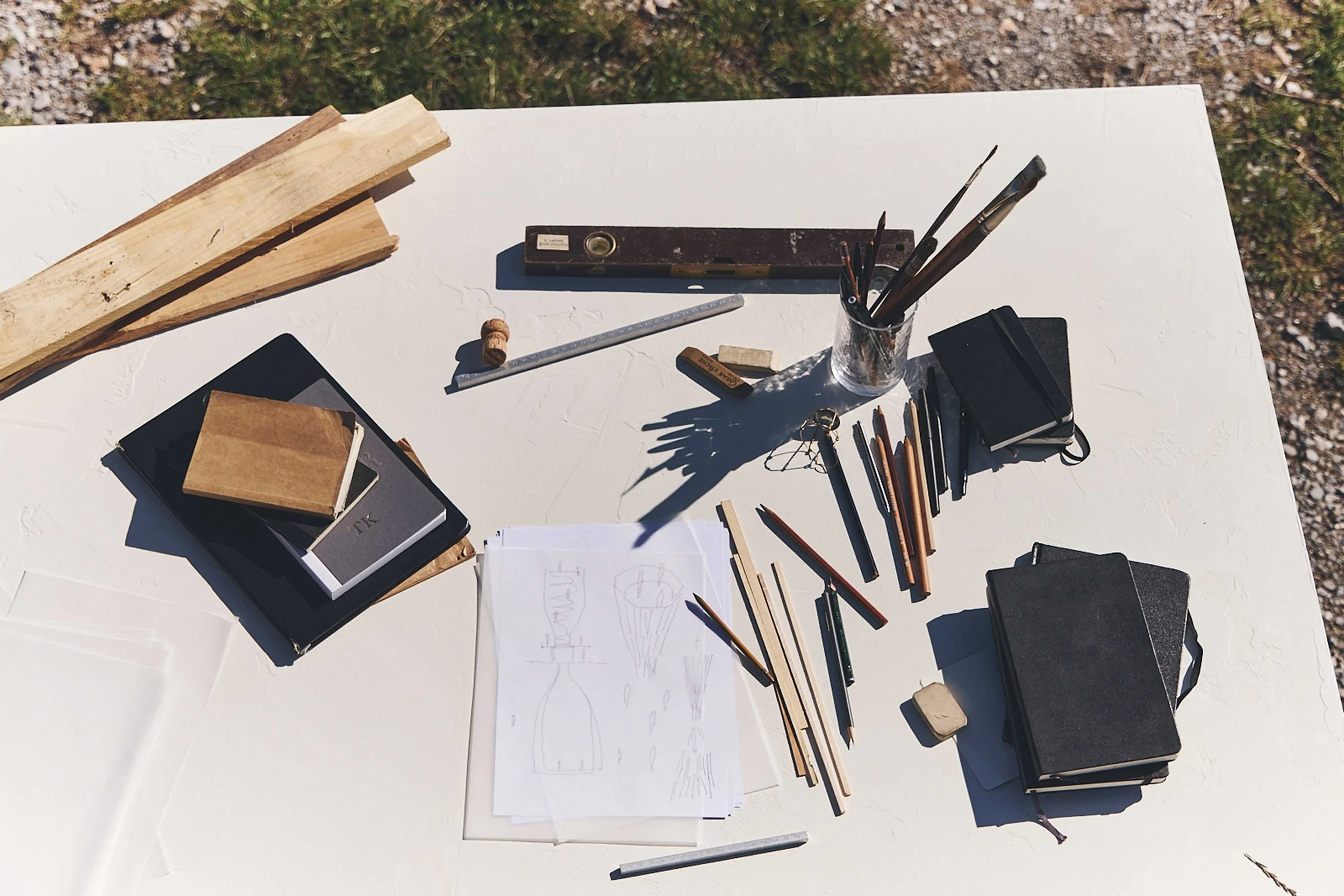
From that moment, Kawamata left the studio behind. Installations migrated into parks, forests, abandoned apartments and city streets. Using discarded timber simply because he couldn’t afford new materials, he unknowingly established the principles that still define his practice: recycling, mobility and responding to place rather than imposing upon it. He describes his creative process: ‘I never have a plan. I prefer being surprised. I wander, observe and feel.’ Drawings and models follow, but only after that first physical encounter with a site. Wood remains his essential language because it carries memory. ‘Each plank tells a unique story,’ he explains. ‘Wood is like skin: it breathes, changes colour and transforms.’
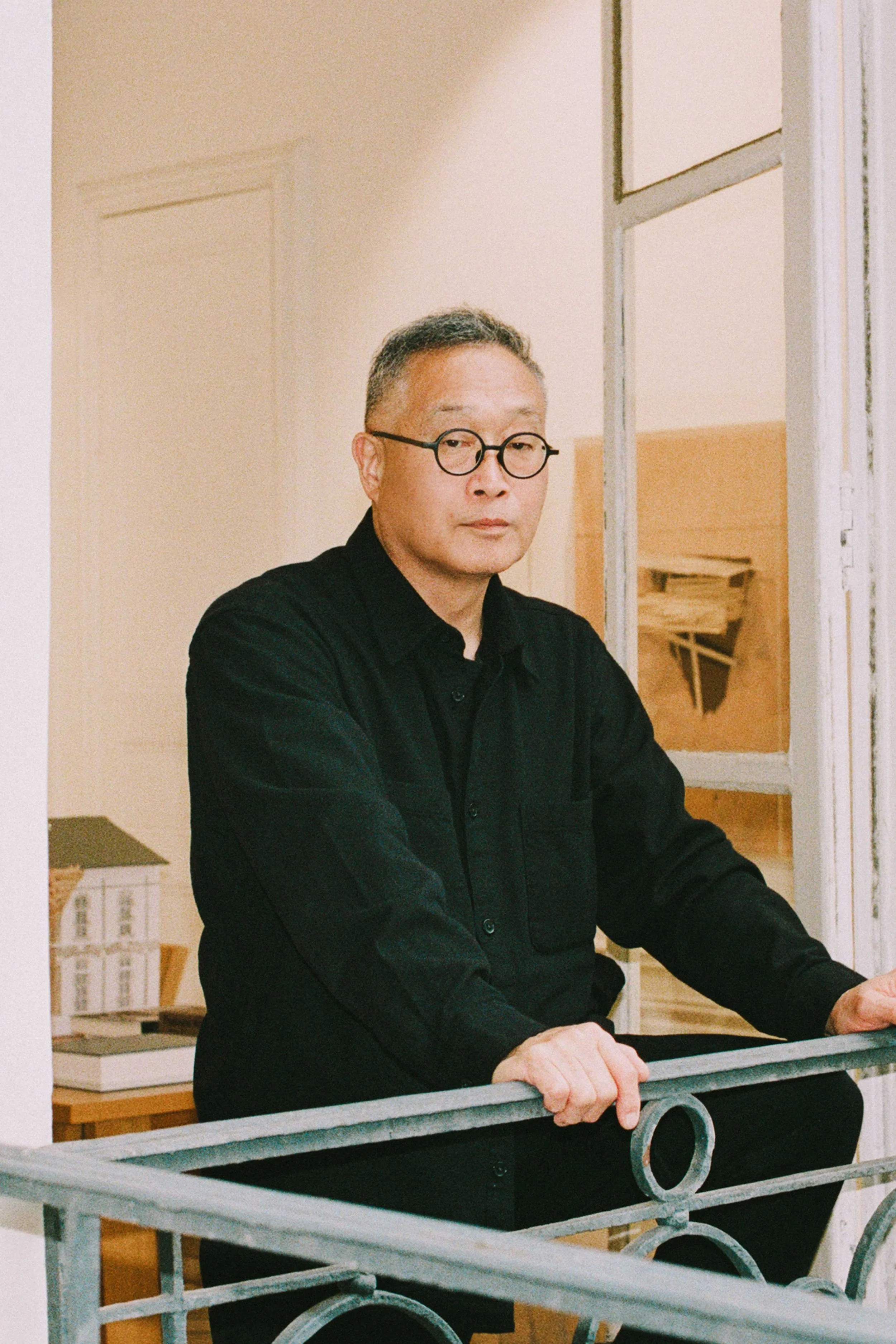
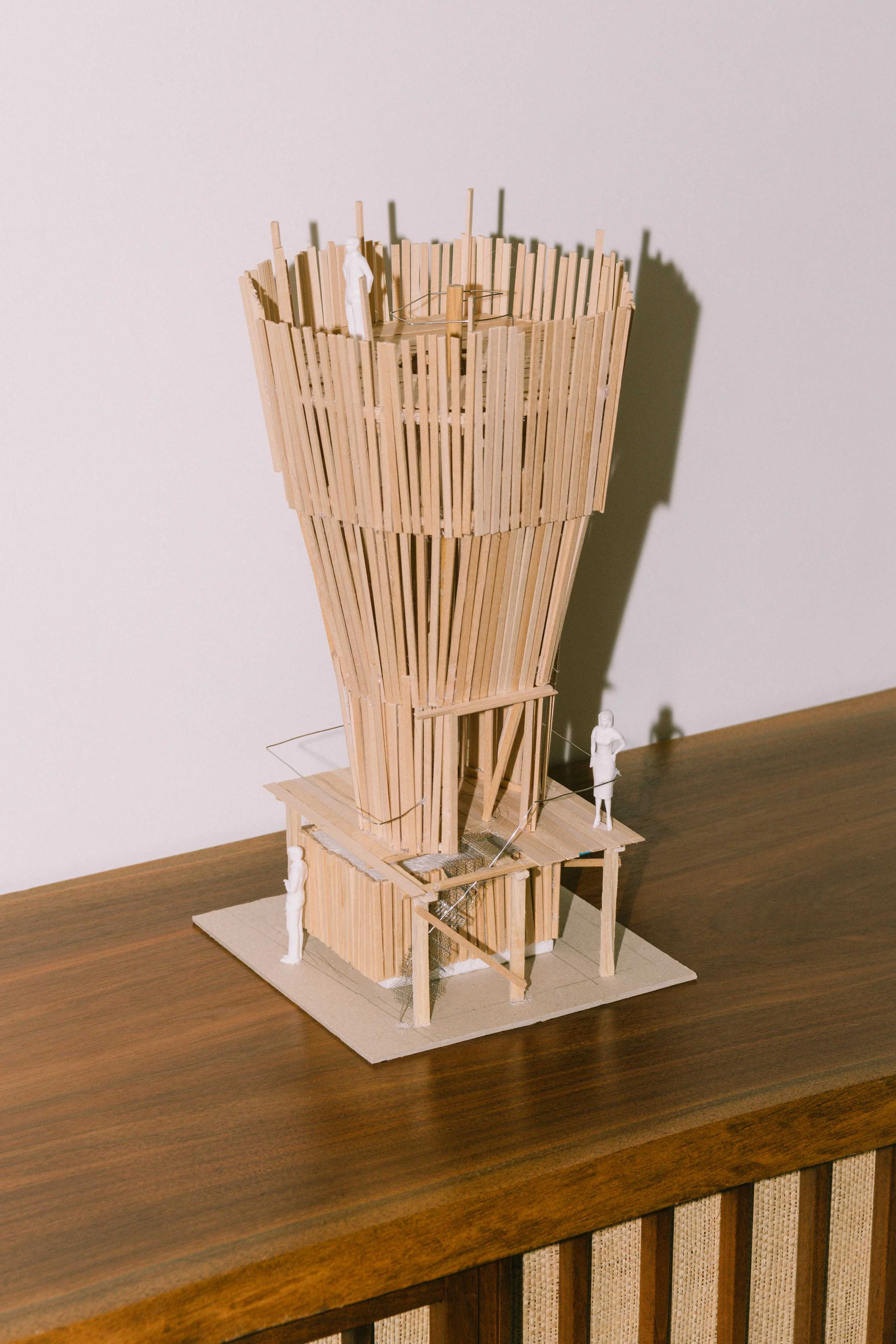
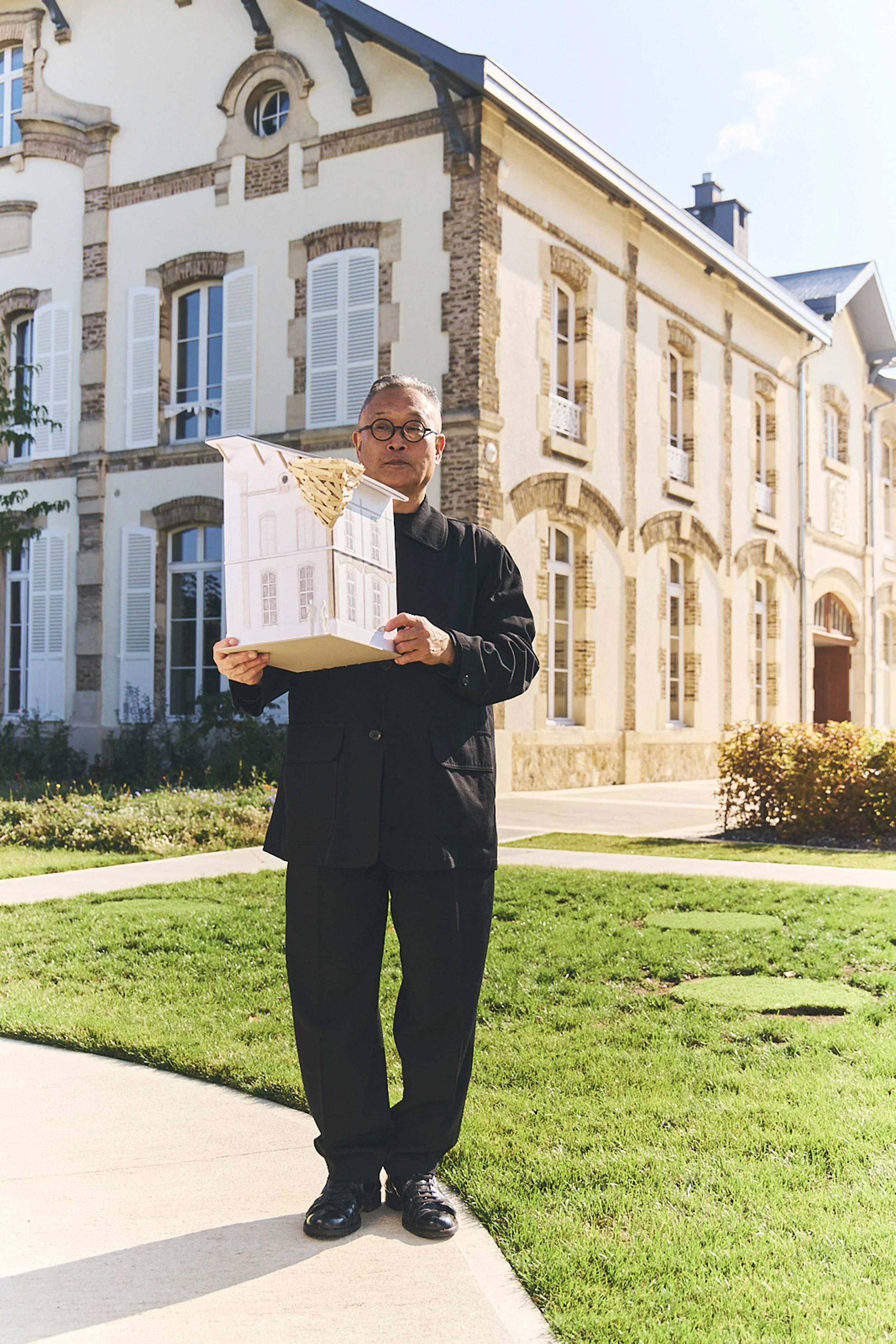
Tadashi Kawamata’s site-responsive installation comprises a series of nest-like structures that connect visitors more closely with nature and the local biosphere, alongside models and paintings (pictured). Photography by Lea Boeglin
That way of thinking resonated deeply at Ruinart. Exploring the vineyards and UNESCO world heritage- listed chalk cellars, Kawamata saw more than picturesque scenery. He discovered parallel worlds where geology, human labour and climate intersect. ‘There is an ongoing dialogue between work and time, culture and nature,’ he says. ‘I wanted to continue this conversation in my work.’
Rather than decorating the maison’s landscape, his installations — Nest, Tree Hut and Observatory — encourage us to inhabit it differently. Nest-like structures evoke shelter and coexistence. The latter, a six-metre tall viewing platform shifts viewers’ perspectives as they catch glimpses of local wine and forest ecosystems and feel the shifting weather. ‘The shape of the tower is like an upside-down bottle of champagne, its spiral staircase like a bubble rising to the sky,’ he adds.
Fragile though they appear, every piece is meticulously engineered, balancing lightness with structural integrity while remaining reversible and respectful of biodiversity. ‘These installations aim to reconnect visitors to nature, to give them a better understanding of the living world and a better inner balance,’ he says.
As the ephemeral has always been central to Kawamata’s practice, his works are assembled, dismantled and reborn elsewhere in an endless cycle of construction and destruction. ‘I build, take down, move to a new site and rebuild, like a travelling circus,’ he says. That rhythm mirrors Ruinart’s own understanding of time. Champagne demands years of cultivation for brief periods of celebration, just as Kawamata’s work culminates in fleeting encounters that linger in memory long after the timber has weathered, greyed or disappeared. ‘I strive to build moments rather than monuments — fragile forms shaped by the human hand and attuned with the elements,’ he concludes. For Conversations with Nature, the artist and maison arrive at the same conclusion: the most enduring things are often those that teach us to appreciate what cannot last.
As part of Conversations with Nature, Tadashi Kawamata’s work will be exhibited at the Ruinart Art & Champagne Bar, Daikanyama T-Site Garden Gallery. The presentation will run from 28 October to 8 November 2026 during Art Week Tokyo.
The Index, Tokyo
Fabien Vallérian, Ruinart’s international director of arts and culture, shares the Tokyo addresses that keep him coming back.
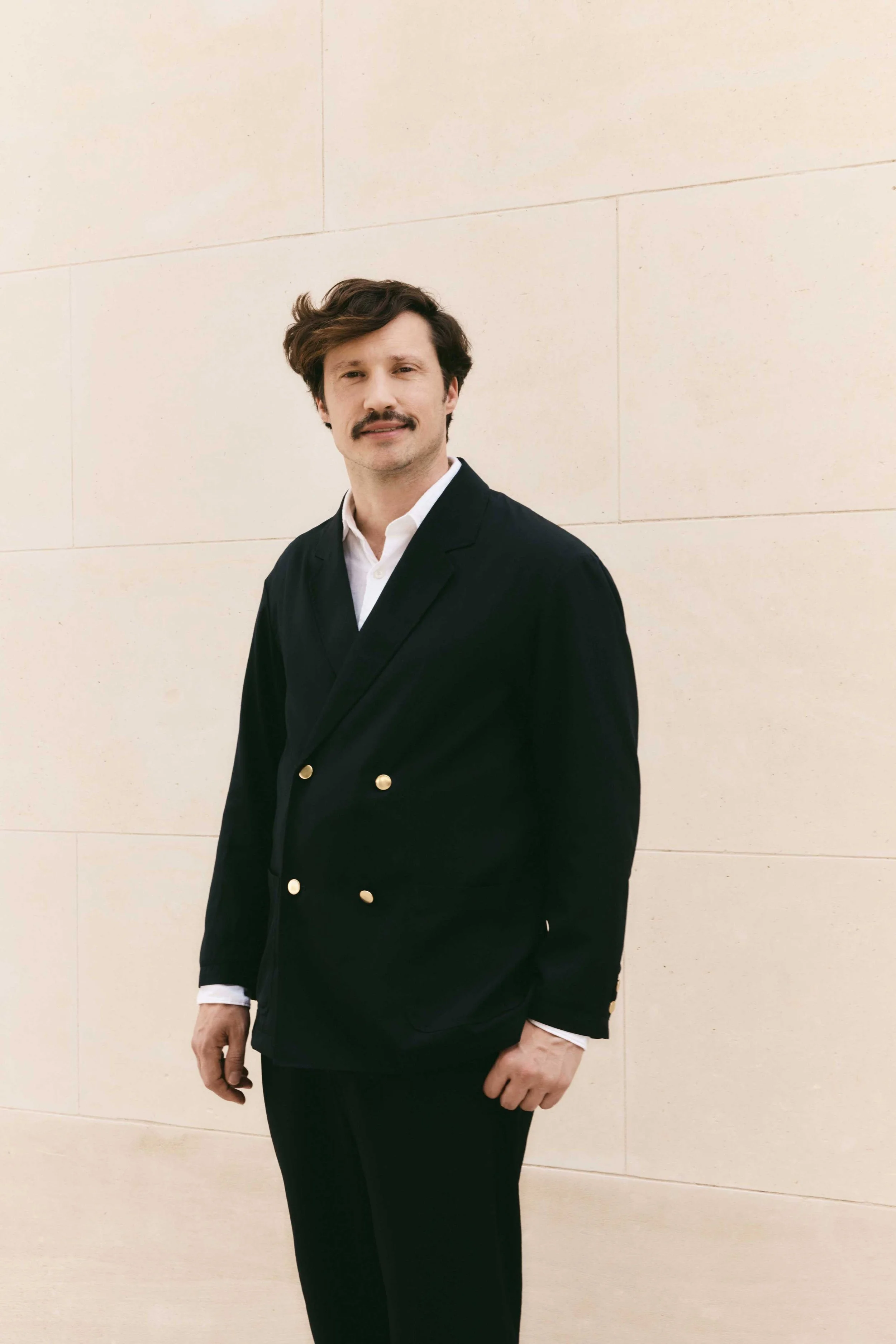
Photography by Alice Jacquemin
Yakumo Saryo by Shinichiro Ogata
I love Yakumo Saryo for the way it distils Japanese hospitality into something extremely quiet and contemporary. Architecture, garden, food, materials and craft are considered as one complete experience, with extraordinary attention to detail.
Kioi Seido by Hiroshi Naito
One of the most intriguing pieces of architecture in Tokyo. I love its mysterious, almost timeless presence and the way concrete, light and shadow create a contemplative atmosphere.
Kyu-Iwasaki-tei Gardens by Josiah Conder
I find the dialogue between Japanese and Western architecture particularly fascinating here. The combination of Conder’s Western-style house, the traditional Japanese house and the garden create a remarkable sense of history and cultural exchange.
Kosoan
One of my favourite places to experience a quieter side of Tokyo. Sitting in this traditional Japanese house, overlooking the garden with a bowl of matcha, creates a rare feeling of stillness and timelessness in the middle of the city.
Ceysson & Bénétière Tokyo
I appreciate the gallery’s thoughtful and rigorous approach to contemporary art. The understated space gives the artists room to breathe, and the programme always makes for an interesting encounter with contemporary art in the middle of Ginza.
Taka Ishii Gallery
Taka Ishii Gallery has been fundamental to Tokyo’s contemporary art and photography scene. I particularly admire its distinctive curatorial vision and the way it connects Japanese artists and perspectives with a wider international art context.
Anonymous Art Cafe & Bar
A hidden bar where the art, design and creative communities of Tokyo come together in an elegant setting.
KameManNen
A wonderful example of Japanese craft at its most precise. I love the timeless quality of the eyewear and the philosophy of making something that’s extremely refined without being extremely designed or decorative.
Matsubaya Saryō
I love the intimacy of Matsubaya Saryō, where tea, bonsai, ceramics and Japanese objects mix in a very personal setting. It offers a quiet glimpse into Japanese culture that feels discovered rather than staged.
Sasha Kanetanaka by Hiroshi Sugimoto
I’m fascinated by the dialogue between Japanese culinary tradition and contemporary art here. Hiroshi Sugimoto’s involvement gives the space a distinctive artistic dimension, creating an experience where food, architecture and art become inseparable.
Mio Harutaka by New Material Research Laboratory
I love the way the space reflects the philosophy of the jewellery itself. Everything is made in Japan, and the interior uses Ryukyu limestone from Okinawa, creating a quiet, tactile atmosphere that feels deeply connected to Japanese craft. The space also features works by Rei Naito and others, creating a beautiful dialogue between jewellery, art, architecture and materials.
Toriman by Hiroshi Sugimoto
A very intimate yakitori experience, accessible through membership. I love the combination of exceptional yakitori, Hiroshi Sugimoto’s architecture and the carefully selected artworks, creating a very personal dialogue between food, architecture and art.